statue of a nymph in love
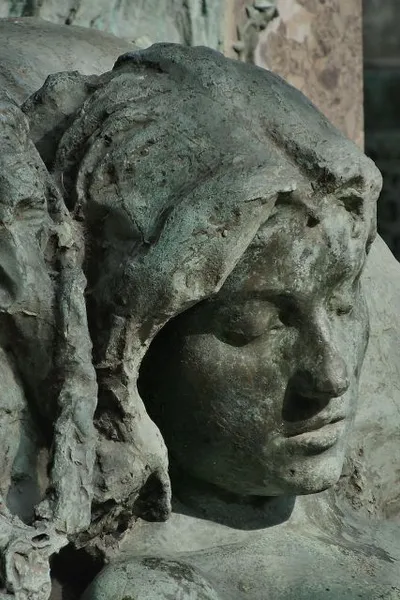
statue of a nymph in love
The house was like a dead child of whom nothing remains; it had once been its own country, its own land; it had had its own gods and magic. And now all of that was dead.
Nothing alive remained in that house. There was nothing left that hadn’t already burned long ago.
I used to go there a lot, but I never went inside the house. It struck me as strange that they’d just left it there—that they’d abandoned it just like that. From a distance, it made me sad; up close, it disgusted me, like a deformity on a body or an infected gash full of pus.
I would walk through the gardens of that dark house—entire groves filled with statues. I was thirteen, and I could stay there until sunset, gazing at those statues: fantasizing about the satyr-men, imagining them as lovers, imagining myself as a running nymph.
Was that how my body would look? Was that how my chest would look? My legs? My lips? I was a girl, but I was always precocious and could spend hours lost in violent fantasies. My childish desire tasted of blood. My first kiss tasted of blood. I never belonged to that childhood dream of innocence; I was always rotten.
One of those days, while I was walking, I came across two statues. They were closer together than statues usually are. It wasn’t a satyr—it had no horns or hooves. It didn’t have a wild face, either. It was like one of the other nymphs, and flowers had grown on its legs—pale pink flowers, lilac and purple flowers.
I had fantasized about satyrs; I had imagined them chasing me, I had imagined the frenzy of giving them my blood and tasting theirs, heating our bodies and spilling blood—the satyrs had given me a vision of cruel and violent sex.
But it was the first time I understood something wilder, something gentler, something crueler. It was the first time I’d fallen in love with something. The first time I’d found something precious.
I felt ashamed and lowered my eyes. And then I found her.
She, too, was made of stone; she, too, was beautiful. But she was different. She was broken stone on that scorched ground.
I picked up one of the fragments from her chest to see if there was a beating heart, and I found a nest of bugs and earthworms that made me recoil in disgust.
I realized I was facing another species: these nymphs, these satyrs (even the wildest ones), belonged to that home that had once been. That land that had disappeared and faded into decay, that had abandoned them in those gardens.
Her homeland was different. She did belong to this corpse. She did belong to this scorched earth and these green trees that had turned almost black. She did belong to this decay, to this abandonment. She, too, was in love with him and was alone. She, too—being something tainted and dirty—loved a purer being. She, too, could only look at him and love him, powerless to do anything.
I would have liked to be able to tell her that, in some way, we belonged to the same race. That we belonged to the same dark homeland, to that nocturnal homeland that made us wild and impure. That made us poisonous like a flower, like a snake.
Ours is the left side of the earth, that place shrouded in shadows.
And we can only have a few minutes of sunlight before descending and disappearing into the twilight.
I plucked one of the flowers growing on his legs and let the nymph hold it in her cold fingers, while insects emerged from her chest like tiny black tears—a dark weeping from the nymph, forever ruined.
I wonder if, when the world ends amid fire and mirrors and the days of destruction and extermination arrive, she will break the pact of all inert beings and accept death just to cling to that pale pink, which had grown at the feet of something she had loved—and which could never have loved her in return.